
If you follow the pharmaceutical industry, or invest in the companies that power it, there is a regulatory deadline you need to have on your radar: November 27, 2026.
That date marks the final enforcement milestone of the Drug Supply Chain Security Act (DSCSA), a federal law that is fundamentally reshaping how prescription drugs are tracked, verified, and exchanged across the United States. For small dispensers; corporate entities with 25 or fewer full-time equivalent pharmacists and pharmacy technicians, this is the hard deadline to achieve full compliance with the law's most demanding requirements.
But to understand why this deadline matters, you first need to understand what the DSCSA actually is and why it took over a decade to get here.
Table of Contents
- A law ten years in the making
- Who must comply: the five key participants
- What "interoperable, electronic, package-level tracing" actually means
- Where the infrastructure gap lives
- The bigger picture
A law ten years in the making
The DSCSA was signed into law in 2013 with an ambitious goal: build an interoperable, electronic system to track and trace every prescription drug package as it moves through the entire US supply chain, from manufacturer to the patient's hands.
The law was designed with three core goals in mind: prevent harmful or counterfeit drugs from entering the supply chain, detect them quickly if they do, and enable rapid removal before patients are harmed.
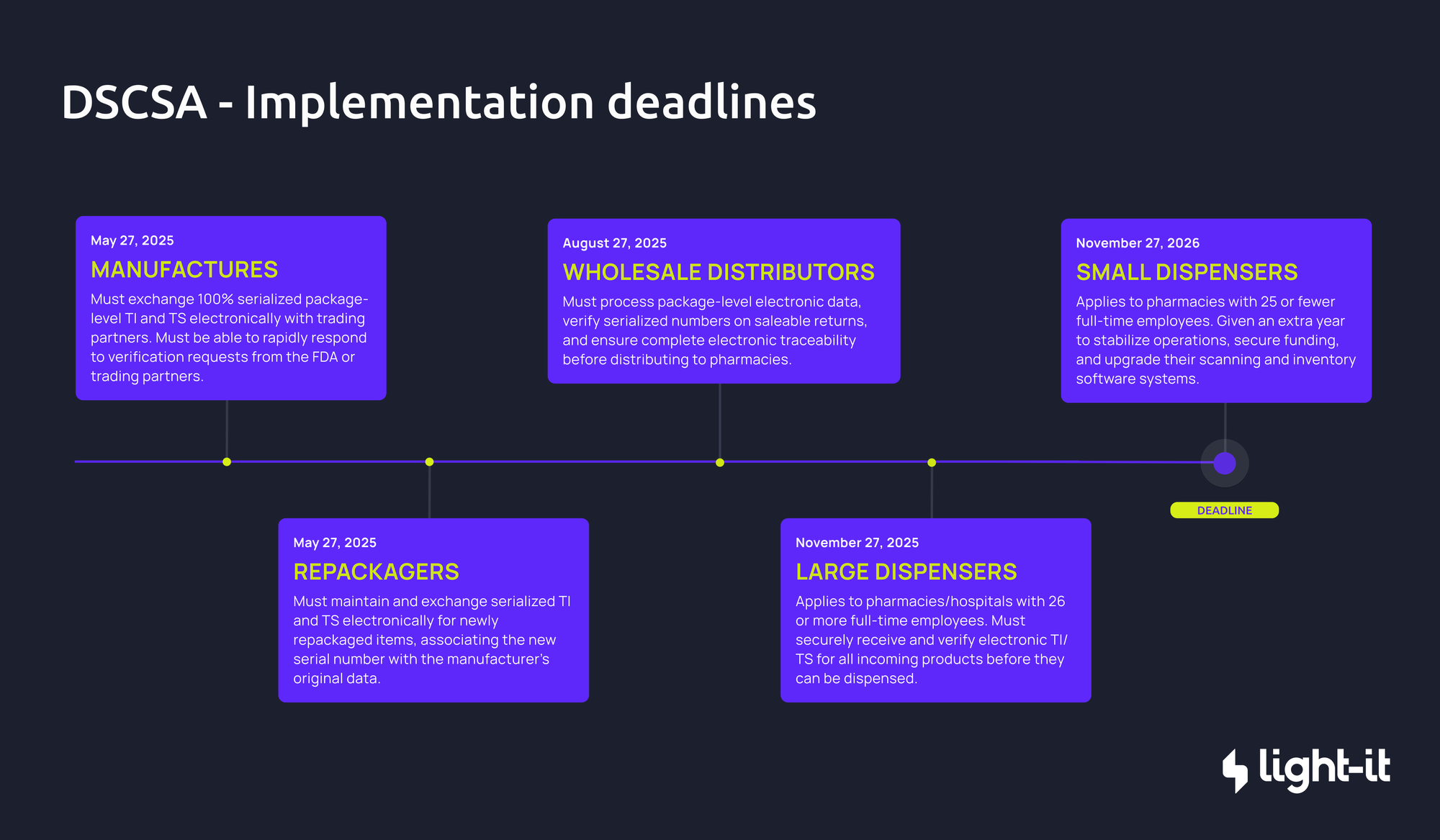
Given the scale of the US pharmaceutical market, the law was designed as a phased, 10-year implementation roadmap. Requirements rolled out gradually across different supply chain participants. Wholesale distributors reached full enforcement in August 2025. Large dispensers followed in November 2025. Small dispensers have until November 27, 2026, a date that is now less than six months away.
The clock is running.
Who must comply: the five key participants
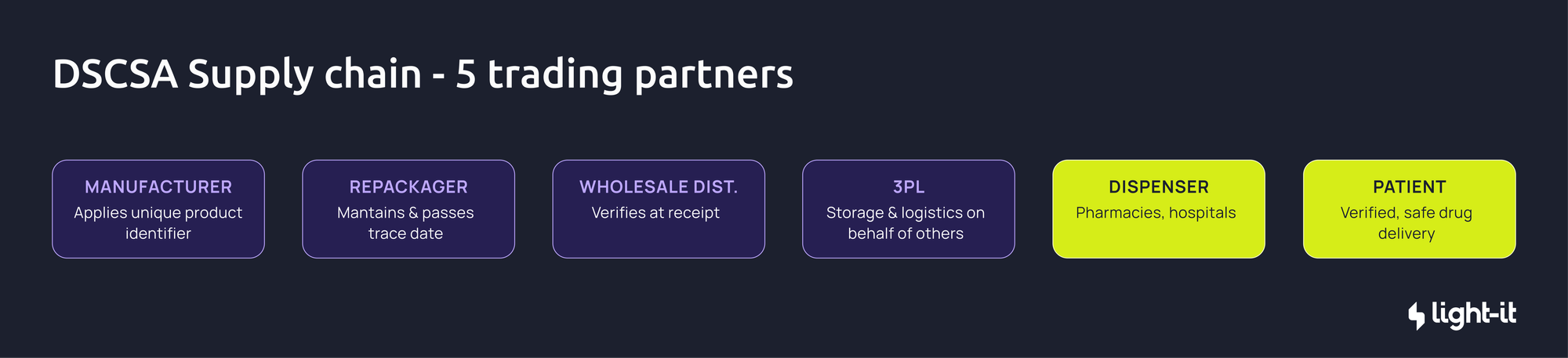
The DSCSA enforces compliance across five categories of trading partners in the drug pipeline:
- Manufacturers: the originators of drug products, responsible for applying a unique product identifier to every saleable package.
- Repackagers: entities that repackage drugs into new containers. A repackager must decommission the original manufacturer's product identifier and assign a new unique identifier to the repackaged product, while maintaining an unbroken chain of traceability data back to the original package.
- Wholesale Distributors: the intermediaries who move products between manufacturers and dispensers at scale.
- Third-Party Logistics Providers (3PLs): companies that handle storage and distribution logistics on behalf of other trading partners.
- Dispensers: pharmacies, hospitals, and clinics that are the final link in the chain before a drug reaches a patient.
Every one of these entities must be able to send, receive, and verify transaction data electronically, at the individual package level, using an interoperable system.
What "interoperable, electronic, package-level tracing" actually means
Prior to DSCSA's final requirements, many supply chain transactions relied on paper records or siloed digital systems that couldn't talk to each other.
Under the enhanced requirements, every time a drug package changes hands, the seller must electronically transmit transaction data to the buyer. This data travels with the product and must be queryable in near-real time. Each package must carry a unique product identifier containing the drug's National Drug Code, serial number, lot number, and expiration date. The industry-standard format for exchanging this data is EPCIS (Electronic Product Code Information Services), a GS1 standard that structures every supply chain event, what moved, where, when, and why, into a machine-readable record that any compliant system can read and store.
When a wholesale distributor receives a saleable return, they must now verify it against the original transaction data before accepting it back into inventory. When a dispenser receives a shipment, they are expected to verify the product at receipt. None of this works without robust, connected technology systems on every side of every transaction.
Where the infrastructure gap lives
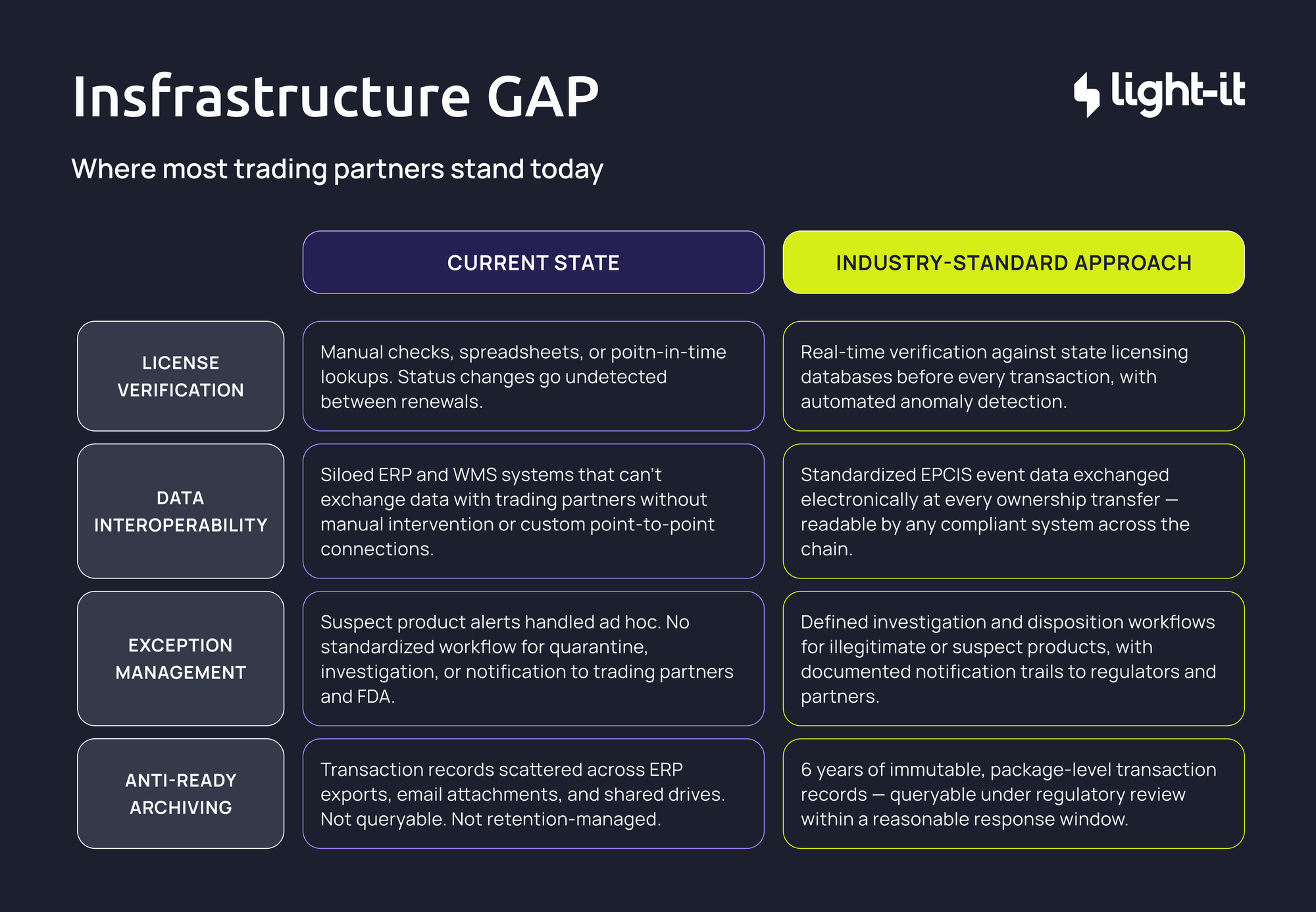
The DSCSA does not prescribe which technology trading partners must use. It prescribes what that technology must accomplish. And right now, for most of the supply chain, that gap between what is required and what actually exists in production is wider than it appears from the outside.
License verification is a good example. Before a wholesale distributor can legally sell to a pharmacy, both parties must verify each other's state licenses. With thousands of licenses across 50 states, each subject to renewal cycles and status changes, this is not a problem that spreadsheets or manual checks can absorb at scale. Yet many trading partners are still handling it that way. The infrastructure to query state licensing databases in real time, reconcile status changes, and surface anomalies automatically exists in some corners of the industry, but it is nowhere near standard.
Data interoperability tells the same story. Trading partners run different ERP systems, warehouse platforms, and pharmacy management software. Getting those systems to exchange DSCSA-compliant transaction data in standardized formats, reliably, at scale, without manual intervention, is genuinely hard. The GS1 standards that underpin the data exchange are well-defined. The implementation layer, across a fragmented and legacy-heavy technology landscape, largely is not.
Some of the gap is less technical than it is regulatory. The DSCSA requires trading partners to respond to verification requests from Authorized Trading Partners, but the law never defined an authentication protocol for proving that status. In practice, a verification request often arrives identified only by a Global Location Number, which is public data. There's no standardized way to confirm the requester is who they claim to be. That ambiguity gives any trading partner a legitimate-sounding reason to simply not respond. The rulebook never specified how "authorized" gets proven. That gap has nothing to do with system failures.
Closing it requires more than better software. The real work is building infrastructure that fills in where the regulation itself stayed silent.
Closing it requires more than better software.
Closing it requires more than better software. The real work is building infrastructure that fills in where the regulation itself stayed silent.
Exception management, package-level verification, and six-year audit-ready data archiving round out a compliance stack that very few companies have fully assembled. Most are patching existing systems and hoping the seams hold.
The bigger picture
The DSCSA represents one of the most significant structural changes to pharmaceutical distribution in US history. It transforms the drug supply chain from a series of loosely connected bilateral transactions into a fully traceable, digitally verifiable network. That transformation is not complete.
For builders and investors paying attention to pharmaceutical infrastructure, that is the signal. The regulatory mandate exists. The deadlines are real. The penalties for non-compliance are not abstract. What is still missing is the foundational layer that makes compliance not just achievable, but operational at scale across a supply chain that spans manufacturers, distributors, dispensers, and repackagers of every size.
The 90-day window before November 27 will separate the infrastructure that gets built from the infrastructure that gets bought. For builders and investors, that's where the opportunity sits: forget selling compliance software to IT departments. The real play is becoming the connective tissue the industry will be scrambling for once the deadline stops feeling theoretical.