

Our security, governance, and compliance standards

From HIPAA-ready architectures to audit trails and PHI-safe workflows — we build systems that survive real-world scrutiny.
Abstract brand graphic featuring a lime-green quarter-circle, white line-art geometric shapes, and the text "CARE & INNOVATION" arranged in a circular path against a dark background.care & innovation
decorative green line

What this means at Light-it

At Light-it, security, compliance, and governance are integrated directly into how we design and deliver solutions, not added later.

SDLC (Secure Software Development Life Cycle)

We embed security and compliance controls across the entire development lifecycle to prevent PHI exposure, audit failures, and costly rework before they happen. This includes rigorous, PHI-aware code reviews, strict secrets management policies that ensure sensitive data never reaches logs, fully isolated environments across dev, staging, and production, and deployment pipelines designed to be audit-ready, with complete traceability and compliance evidence built in by default.

Regulatory-Aware Product Strategy

We don’t treat compliance as a checkbox exercise, we design products that naturally operate within regulatory constraints. This means clearly defining what constitutes PHI and how it flows across the system, understanding when regulations like HIPAA actually apply, and shaping product scope early to avoid building features that will later require costly rework or introduce risk. Instead of “doing compliance” at the end, we ensure the product is designed from day one to not break it.

Risk-First Architecture

We intentionally design data flows, integrations, and access models to ensure resilience, traceability, and protection of sensitive information. Every architectural decision is evaluated through a risk lens from the outset — including threat modeling, least-privilege access controls, encryption at rest and in transit, and clear data residency boundaries. This means that when audits or incidents occur, the system is already built to respond, not retrofitted under pressure.

Governance Embedded in Delivery

Clear ownership, documentation standards, and change management practices are part of how we operate, supporting long-term system integrity. We define accountability at every layer of the delivery process — from code ownership and review gates to release approvals and incident response protocols. Governance isn't a separate workstream; it's woven into our day-to-day engineering culture, ensuring that nothing ships without the appropriate visibility, sign-off, and audit trail in place.

Real-world examples

We’ve built and operated systems where compliance, AI, and sensitive data handling are not theoretical concerns, they are core architectural constraints.
Logo for 'CompliantChatGPT' featuring a silver shield icon with a medical cross, set against a dark background of blurred computer code to represent secure and compliant AI for healthcare.

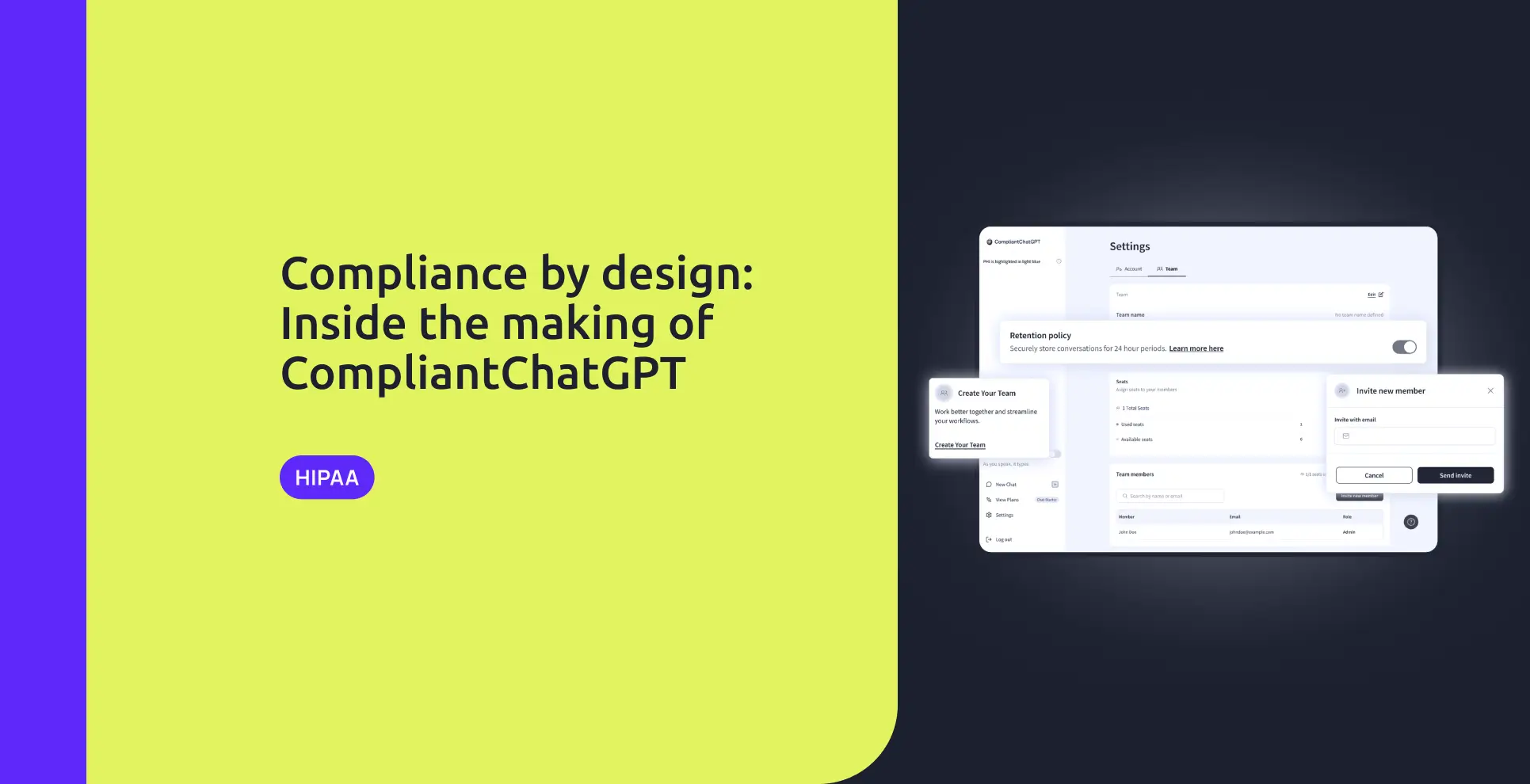
CompliantChatGPT: Healthcare Data Analytics Infrastructure

Designed HIPAA-compliant healthcare data pipelines and analytics layers enabling secure AI usage and healthcare data analytics workflows in regulated environments.

Results:

  • Powered data-driven growth through a behavior-based analytics foundation.
  • Real-time AI streaming with PHI anonymization.
  • Configurable data retention & compliance policies.

Professional dashboard layout for a 'Healthcare Data Migration & Analytics Platform' featuring a dark-themed UI with clean line-art icons representing data flows, patient profiles, and performance metrics.

Psychnow

Serverless AI pipelines that handle ingestion, transformation, and model interaction at scale, with compliance and traceability built into every layer of the architecture.

Results:

  • Cut intake consultation time in half through optimized clinical workflows.
  • 99%+ patient completion rate driven by intuitive, friction-free UX.
  • End-to-end compliance maintained across all pipeline stages.

Industry standards expertise

We're HIPAA-compliant and have helped healthcare companies achieve SOC 2 certification. We also work closely with leading platforms like AWS, Databricks, Snowflake, and Azure.

partners & TECH STACK

AWS
Google Cloud
Databricks
Snowflake

REGULATIONS EXPERTISE

HIPAA logo
HIPAA
SOC2 logo
SOC2
GDPR logo
GDPR
CCPA
PHIPA & PIPEDA
vectorial and abstract modern design with bright colors

Get it right from the start

Security, governance, and compliance shouldn’t be an afterthought. We build them in from day one.

Talk to our experts

Our foundations

Trust is built on structure. The way we design, develop, and deliver healthcare technology is grounded in four core pillars that guide every project.These pillars define how we manage risk, protect sensitive information, and support regulated environments, from early discovery through long-term product evolution.

For more details, visit our Trust Center

security

Security is built into our development lifecycle from day one, shaped by real healthcare use cases where sensitive patient data demands strict control and traceability.

We design architectures that keep PHI secure at every step:

Role-based access enforcement and encryption in transit and at rest

Clinical data structured, timestamped, and locked when finalized

Full audit trails to meet integrity and legal standards

Data isolation across environments to prevent cross-environment exposure

Audit-ready pipelines with end-to-end traceability

This is not security layered on top. It is systems designed to handle clinical data safely by default.

Governance

Effective governance means knowing who is responsible for every data flow. We embed governance frameworks directly into the development lifecycle so decisions align with HIPAA and other healthcare regulations from the start:

Continuous risk assessments tied to active development cycles

Clear accountability across teams and vendors

Managed vendor relationships that reduce third-party exposure

The result: you stay audit-ready while your team stays focused on building.

Compliance

Compliance is built into our architecture, not added as an afterthought.

We implement the right controls at every touchpoint:

PHI flow mapping to enforce the "minimum necessary" standard

FHIR adoption for interoperability when requirements call for it

Strong encryption and key management across all data layers

Automated logging and continuous monitoring for audit readiness

We track evolving regulations so your architecture stays compliant without constant rework.

Privacy

Privacy by Design is our operating model, not a policy checkbox.

We apply privacy controls at the architecture level:

Collect only what is needed; unnecessary identifiers are suppressed

Controls embedded directly into APIs and clinical workflows

Role-based access and strong identity safeguards on all records

Testing conducted in isolated sandboxes using synthetic or de-identified data

Patient confidentiality is preserved without slowing down development.

Learn from our Experts

Discover our exclusive contents on Healthcare innovation.

The approach

What is healthcare QA, and why does it require a specialized approach?

  • Healthcare QA is quality assurance designed for software that handles Protected Health Information (PHI) and clinical workflows. It goes beyond finding defects to validate patient safety, multi-role permissions, and audit-ready evidence. Generic QA misses healthcare-specific risks such as broken data flows between systems, role mismatches, and ambiguous clinical workflows.
What does "embedded QA" mean in software development?
  • Embedded QA means quality engineers are part of the product team from day zero, not a final-stage gate. At Light-it, QA participates in discovery, defines risk-based release criteria, and continuously validates patient, clinician, and admin workflows. The result: fewer production incidents, fewer last-minute surprises, and defensible release decisions.
How do Light-it's two QA engagement models work?
  • We offer two modes. In the first, QA is embedded inside a full Light-it product team quality-by-design from day zero. In the second, our QA engineers embed inside your existing team, mapping your domain and risks first, then progressively raising standards through templates, regression strategy, and shared risk priorities. No disruption to current workflows.
Does Light-it test web apps, mobile apps, or both?
  • Light-it QA covers web UI, cloud applications, mobile, API and integration validation, and data-flow verification. Coverage is organised around healthcare risk in three areas: product and workflow validation, integrations and interoperability, and data, security, and permissions. Performance engineering and penetration testing are scoped as separate engagements when needed.
When in the product lifecycle should QA start?
  • The earlier, the better. Light-it's framework integrates QA from discovery and design, when requirement gaps, multi-role workflow issues, and PHI-handling decisions are cheapest to fix. Bringing QA in only at release stage means buying expensive surprises and shipping with reduced audit evidence. Our embedded model covers discovery, development, release, and maintenance.
How does embedded QA reduce production incidents?
  • By validating complete user journeys (patient, clinician, admin) under real-world conditions before go-live, our QA process catches workflow, data, and permission failures earlier than ticket-based testing. Risk-based regression design and structured release-readiness reporting mean fewer surprises post-deploy and faster root-cause analysis when issues do occur.

Compliance & Legal

Does Light-it handle PHI (Protected Health Information) during testing?
  • We don't use real PHI in our testing or AI tooling. Our default is masked or synthetic data, with strict separation between production and test environments. We validate role-based access, data-handling logic, and authorisation behaviour across systems and environments to ensure HIPAA-aligned operations throughout the product lifecycle.
Does Light-it provide HIPAA compliance audits?
  • A formal HIPAA compliance audit isn't included by default in QA engagements, it's typically scoped separately, often with a certifying body. Our QA validates that role-based access, PHI handling, and permission logic behave correctly, which supports HIPAA-aligned operations and produces defensible evidence, but doesn't replace a formal audit.
How does Light-it use AI in healthcare QA testing?
  • AI accelerates test design and ideation, never sign-off. We follow strict principles: no real PHI in AI systems, masked or synthetic data only, human review before validation, and humans remain accountable for risk decisions. AI handles scale; humans hold judgment so clinical responsibility stays real — in healthcare, no algorithm signs off on patient safety.
What does "audit-ready evidence" mean in your QA process?
  • Audit-ready evidence is structured, traceable documentation that supports go/no-go decisions and stands up to regulatory review. It includes release-readiness reports, risk dashboards, regression scope definitions, role-and-permission verification logs, and root-cause analysis. The goal: every release decision is informed, measurable, and defensible.
Are accessibility audits relevant for HIPAA-regulated products?
  • Accessibility and HIPAA are separate frameworks, but patient-facing healthcare products often face both ADA and HIPAA obligations. WCAG 2.1 AA is the recognised standard for the ADA in digital products. Our audit reduces legal and UX risk by turning accessibility gaps into a prioritised remediation backlog — especially relevant for patient portals and intake flows.
decorative green line

Learn more about how we work

The frameworks and standards on this page are how we think. These are the services we offer to put them into practice.

Data Engineering

Clinical data infrastructure that's compliant, interoperable, and enterprise-ready.
See how it works

HIPAA-Compliant Infrastructure Accelerator

Deploy a production-ready HIPAA foundation in weeks, not months.
See the Accelerator

Healthcare Data Migration Accelerator

Move sensitive clinical data securely across EHR, CRM, and RCM systems
See the Accelerator

Frequently Asked
Questions

Learn everything about us and the way we work

Light-it team reviewing healthcare software documentation together
What compliance frameworks does Light-it support?
  • Light-it has direct expertise in HIPAA, SOC2, GDPR, CCPA, and PHIPA & PIPEDA. We work with clients building for the US healthcare market, EU data subjects, and multi-jurisdictional platforms that must satisfy more than one regulatory framework simultaneously.
Does Light-it sign Business Associate Agreements (BAAs)?
  • Yes. Any engagement involving systems that handle Protected Health Information (PHI) on behalf of a covered entity requires a BAA, and Light-it executes BAAs as a standard part of onboarding.
Does working with Light-it make my product HIPAA-certified?

No, and any vendor claiming to offer HIPAA certification should be a red flag. HIPAA has no official certification program. What Light-it delivers is a system designed and documented to meet HIPAA's technical, administrative, and physical safeguard requirements, giving you the evidence posture needed for audits, enterprise deals, and due diligence.

How does Light-it protect PHI during development and testing?
  • PHI never enters non-production environments. Development and QA work is conducted using synthetic or de-identified data in fully isolated environments. Code reviews are PHI-aware, secrets never reach logs, and audit-ready pipelines are standard across all delivery work.
What does 'compliance by design' mean in practice?
  • It means compliance controls are embedded at the architecture level from the first sprint — not retrofitted before a security review. This includes threat modeling during design, least-privilege access from day one, PHI flow mapping before any feature ships, and deployment pipelines built to produce audit evidence by default.
Can Light-it help if our existing product already has compliance gaps?

Yes. We conduct gap assessments against HIPAA and relevant frameworks, identify the highest-risk exposures, and prioritize remediation in a way that minimizes disruption to ongoing product development. Our HIPAA Infrastructure Accelerator is specifically designed for teams inheriting systems that need to reach a compliant baseline.

What is the difference between your Trust Center and the HIPAA Accelerator?

The Trust Center describes how Light-it approaches security and compliance across all engagements, our principles, practices, and the standards we hold ourselves to. The HIPAA Accelerator is a deployable product: pre-built AWS infrastructure, application security patterns, and a QA suite that gives teams a validated HIPAA-compliant baseline in weeks rather than months.

How does Light-it's compliance approach differ from a general software development firm?

General firms build features and treat compliance as a separate workstream or a pre-launch checklist. Light-it structures compliance into the delivery process itself, risk assessments tied to active sprints, PHI-safe code review standards, governance embedded in change management, and architecture decisions evaluated through a regulatory lens from the start. The result is a system that survives real-world scrutiny.

Compliance Scope & Standards

What compliance frameworks does Light-it support?

  • Light-it has direct expertise in HIPAA, SOC2, GDPR, CCPA, and PHIPA & PIPEDA. We work with clients building for the US healthcare market, EU data subjects, and multi-jurisdictional platforms that must satisfy more than one regulatory framework simultaneously.
Does Light-it sign Business Associate Agreements (BAAs)?
  • Yes. Any engagement involving systems that handle Protected Health Information (PHI) on behalf of a covered entity requires a BAA, and Light-it executes BAAs as a standard part of onboarding.
Does working with Light-it make my product HIPAA-certified?
  • No, and any vendor claiming to offer HIPAA certification should be a red flag. HIPAA has no official certification program. What Light-it delivers is a system designed and documented to meet HIPAA's technical, administrative, and physical safeguard requirements, giving you the evidence posture needed for audits, enterprise deals, and due diligence.

Practices & Services

How does Light-it protect PHI during development and testing?

  • PHI never enters non-production environments. Development and QA work is conducted using synthetic or de-identified data in fully isolated environments. Code reviews are PHI-aware, secrets never reach logs, and audit-ready pipelines are standard across all delivery work.
What does 'compliance by design' mean in practice?
  • It means compliance controls are embedded at the architecture level from the first sprint — not retrofitted before a security review. This includes threat modeling during design, least-privilege access from day one, PHI flow mapping before any feature ships, and deployment pipelines built to produce audit evidence by default.
Can Light-it help if our existing product already has compliance gaps?
  • Yes. We conduct gap assessments against HIPAA and relevant frameworks, identify the highest-risk exposures, and prioritize remediation in a way that minimizes disruption to ongoing product development. Our HIPAA Infrastructure Accelerator is specifically designed for teams inheriting systems that need to reach a compliant baseline.
What is the difference between your Trust Center and the HIPAA Accelerator?
  • The Trust Center describes how Light-it approaches security and compliance across all engagements, our principles, practices, and the standards we hold ourselves to. The HIPAA Accelerator is a deployable product: pre-built AWS infrastructure, application security patterns, and a QA suite that gives teams a validated HIPAA-compliant baseline in weeks rather than months.
How does Light-it's compliance approach differ from a general software development firm?
  • General firms build features and treat compliance as a separate workstream or a pre-launch checklist. Light-it structures compliance into the delivery process itself, risk assessments tied to active sprints, PHI-safe code review standards, governance embedded in change management, and architecture decisions evaluated through a regulatory lens from the start. The result is a system that survives real-world scrutiny.
Your Vision. Our Execution.
Two web developers share a screenshot showing code for a digital health product

Start a conversation

Tell us about your initiative. Our team will follow up within one business day.

Name*
Email *
Phone number *
Type of project *
E.g. End-to-end
Project details *
Budget *
E.g. 150k - 500k
How did you hear about us? *
E.g. Social media

By submitting, you agree to our Privacy Policy.

Thank you!
Your submission has been received!
Oops! Something went wrong while submitting the form.